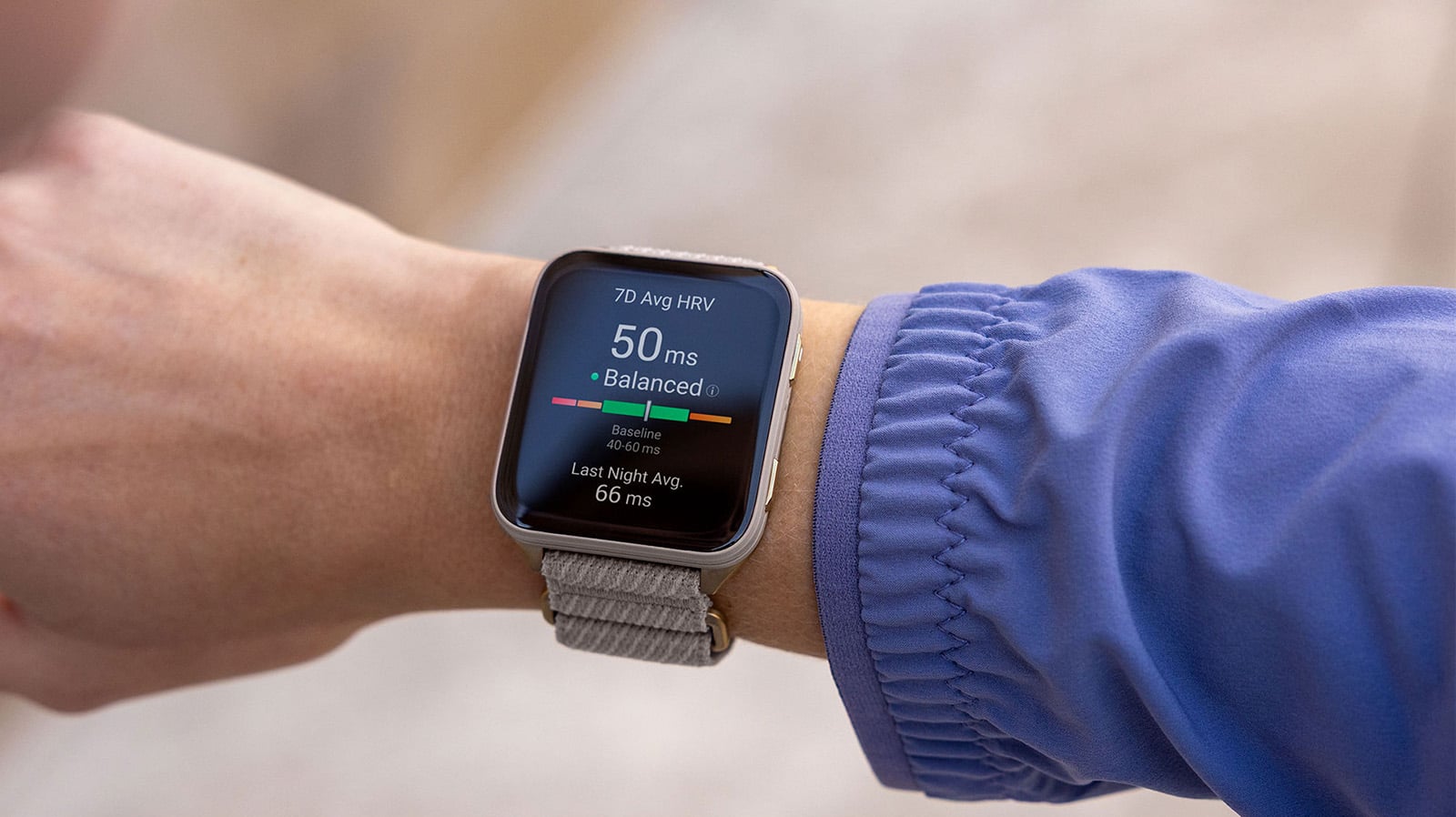
What Is HRV? Heart Rate Variability, Normal Range and How to Improve HRV
Have you ever had a full night’s sleep but still woken up feeling more tired than expected? Or noticed that a workout you normally handle comfortably suddenly feels harder?
Along with metrics such as heart rate, sleep and stress, heart rate variability (HRV) can provide additional insight into how your body is responding to everyday demands, training and recovery.
Unlike heart rate, HRV is not about how many times your heart beats per minute. Instead, it looks at the small variations in timing between individual heartbeats.
And when it comes to HRV, higher is not always better.
HRV varies considerably from person to person, so rather than comparing your number with someone else’s, it is more useful to understand your own personal baseline and monitor how your HRV changes over time.
What Is HRV (Heart Rate Variability)?
Heart rate variability (HRV) refers to the variation in time between consecutive heartbeats, usually measured in milliseconds (ms).
Your heart does not beat like a metronome at perfectly even intervals. Even when your heart rate appears steady, there are small differences in the amount of time between each heartbeat.
These variations are influenced by your autonomic nervous system, including the sympathetic and parasympathetic nervous systems, which help regulate how your body responds to activity, stress, rest and recovery.
Changes in HRV may be associated with factors such as:
- Sleep quality and duration
- Physical and psychological stress
- Training load
- Recovery
- Alcohol and other lifestyle habits
- Changes in daily routine
- Your overall physical condition
However, HRV is highly individual. One person may naturally have a much higher or lower HRV than another.
For this reason, HRV is generally most useful when you compare your current values with your own long-term baseline rather than with another person’s number.
What Is a Good or Normal HRV?
There is no single HRV value that can be considered “good” or “normal” for everyone.
HRV can vary according to factors including age, sex, fitness level, physical activity, sleep, lifestyle and individual physiology.
A number that is normal for one person may therefore be very different from what is normal for someone else.
Instead of trying to reach a universal HRV target, look at whether your HRV remains relatively stable within your personal range and how that range changes over time.
For Garmin users, this personal context is one of the key principles behind HRV Status.
Related reading: Learn how Garmin calculates your seven-day average, personal baseline and HRV Status in Understanding the HRV Status on Your Garmin Smartwatch
Why Is My HRV Low? 4 Common Factors That Can Affect HRV
A lower-than-usual HRV does not automatically mean something is wrong.
HRV naturally fluctuates from day to day. Rather than focusing on one reading, consider what has changed recently in your sleep, training, stress levels and daily habits.
1. Stress and Lack of Sleep
Both physical and psychological stress can affect your autonomic nervous system and HRV.
Work stress, insufficient sleep, inconsistent sleep schedules or poor sleep quality may be reflected in changes to your overnight HRV.
If your HRV is below your usual range, review it together with your recent sleep duration, sleep score and stress data rather than interpreting HRV in isolation.
Learn more about how Garmin analyzes sleep on the Garmin Sleep Tracking page.
2. Increased Training Load and Insufficient Recovery
Hard workouts, increased training volume or several demanding training days in a row may temporarily affect HRV.
For runners and athletes, HRV can be considered alongside metrics such as sleep, training load, recovery time, Body Battery and Training Readiness to provide additional context about how your body is responding.
Related reading: See how HRV can be used alongside exercise and recovery data in An Alternative Reference Index to Monitor Fatigue – Heart Rate Variability (HRV).
3. Lifestyle Habits
Changes in everyday habits can also affect sleep, recovery and HRV.
Factors may include:
- Alcohol consumption
- Changes in caffeine intake
- Travel
- Meal timing
- Late nights
- Changes in your usual routine
Instead of trying to explain every individual HRV fluctuation, look for patterns across several days or weeks.
4. Physical Stress or Feeling Unwell
Your HRV may also change when your body is under increased physiological stress.
However, HRV is not a diagnostic tool.
A lower HRV reading alone cannot determine whether you are ill or identify a medical condition. If unusual data is accompanied by symptoms or you feel unwell, seek advice from a qualified healthcare professional.
Why Does Garmin Measure HRV While You Sleep?
Compatible Garmin devices continuously analyse HRV during sleep, allowing you to review your overnight average as well as changes across the night. Measuring HRV under relatively consistent overnight conditions also makes day-to-day comparisons more meaningful.
Over time, this allows Garmin to establish your personal HRV baseline and give your overnight HRV greater context.
Rather than repeating how the seven-day average, baseline and HRV Status categories work here, see:
Understanding the HRV Status on Your Garmin Smartwatch for a detailed explanation of Garmin HRV Status.
How Should I Read My Garmin HRV Trend?
| What You See | What It Means to Check |
|---|---|
| HRV within your usual baseline | Consider it alongside sleep, Body Battery and Training Readiness |
| One night below your usual range | Review recent sleep, stress, training and lifestyle changes |
| Several days below baseline | Focus on the longer-term trend and your overall recovery |
| HRV above your usual baseline | Higher is not automatically better; compare it with your personal baseline |
| No HRV Status yet | Keep wearing your compatible Garmin watch during sleep while your baseline is established |
How to Use HRV With Sleep, Body Battery and Training Readiness
HRV becomes more useful when considered together with other information about your body.
Compatible Garmin devices combine physiological, sleep and activity data across several features to provide a more complete view of stress and recovery.

Morning Report
On compatible Garmin smartwatches, Morning Report provides an overview of information collected overnight, which may include sleep, HRV Status and other personalised information.
This allows you to start the day with additional context about your recent recovery rather than looking at HRV alone.
Body Battery
Body Battery uses HRV, stress, sleep and activity data to estimate your body’s available energy and show how it changes throughout the day.
HRV and Body Battery are not the same metric.
HRV provides physiological information related to beat-to-beat variation, while Body Battery combines multiple signals to provide a more accessible view of how your energy resources are changing.
Training Readiness
For runners and athletes, Training Readinessprovides another layer of context.
Depending on the compatible device, Training Readiness considers factors including:
This is why a single HRV value should not automatically determine whether you complete a difficult workout.
Consider your HRV together with your recent training, sleep, recovery information and how you actually feel.
How to Improve HRV? 4 Habits That Can Support Recovery
There is no need to try to make your HRV as high as possible.
Instead, focus on habits that support recovery and help your HRV remain relatively stable within your personal baseline over time.
1. Get Consistent, Sufficient Sleep
Sleep plays an important role in physical recovery and overnight HRV.
Try to maintain reasonably consistent sleep and wake times and allow enough time for sleep each night.
Rather than focusing on a single night, use your sleep data and HRV trends over several days to identify longer-term patterns.
2. Balance Exercise and Recovery
Regular physical activity supports health and fitness, but adaptation also requires adequate recovery.
If your HRV remains below your normal range during a demanding training period, review your recent training load together with sleep, Body Battery, recovery time, Training Readiness and how you feel.
Adjusting training intensity or prioritising recovery may sometimes be more useful than simply pushing through your original training plan.
3. Manage Everyday Stress
HRV can respond to psychological and everyday stress as well as exercise.
Work demands, travel and a lack of downtime may all affect how your body responds.
On compatible Garmin smartwatches, Breathwork activities can guide you through slow and controlled breathing exercises when you want to take time to relax.
4. Pay Attention to Lifestyle Patterns
Lifestyle habits can influence both sleep and recovery.
If your compatible Garmin device supports lifestyle logging, you may be able to record habits such as caffeine and alcohol consumption and review them alongside sleep, stress and other health data in Garmin Connect.
Rather than drawing conclusions from one day, look for recurring relationships between your habits and your HRV trends.
Track HRV Consistently Over Time
Consistency is particularly important when interpreting HRV.
Wear your compatible Garmin device while sleeping so that it can collect overnight HRV data and establish your personal baseline.
Longer-term trends generally provide more meaningful context than one unusual night or comparisons with another person’s HRV.
The goal is not to achieve the highest possible HRV. Instead, focus on sustainable habits that support sleep, recovery, activity and stress management.
Watch: How to View Your HRV Status
Garmin HRV Status vs. Health Snapshot: What’s the Difference?
Compatible Garmin devices can provide HRV information in different ways depending on the feature.
HRV Status and Health Snapshot are designed for different purposes.
| Feature | HRV Status | Health Snapshot |
|---|---|---|
| How it works | Automatically records HRV during sleep | Manually started measurement |
| Main purpose | Follow overnight HRV and longer-term trends | Capture several physiological metrics at one point in time |
| HRV context | Uses overnight data and personal baseline | Records HRV during the measurement session |
| Other information | Integrates with recovery and training features | Can record heart rate, HRV, Pulse Ox, respiration and stress on compatible devices |
| Best suited for | Understanding longer-term HRV and recovery trends | Capturing several health metrics during a dedicated session |

If your main goal is to understand how Garmin establishes your personal HRV baseline and interprets your seven-day average, read:
Understanding the HRV Status on Your Garmin Smartwatch
For Health Snapshot compatibility and instructions, visit Garmin Support.
Which Garmin Watch Is Best for Tracking HRV and Recovery?
Many Garmin smartwatches and GPS sports watches support HRV-related features, but feature availability varies by model.
Rather than choosing a watch based on HRV alone, consider your primary activities and the other health or training information you want to use.
| Primary Use | Garmin Series to Consider | Recommended Models |
|---|---|---|
| Running, marathon and triathlon | Forerunner | Forerunner 70/170, Forerunner 570, Forerunner 970 |
| Outdoor activities, hiking and multisport | fēnix | fēnix 9, fēnix 8 |
| Health, fitness and everyday use | Venu, vívoactive | Venu 4, Venu X1, vívoactive 6 |
| Outdoor activities and durability | Instinct | Instinct 3 |
Explore Garmin smartwatches in Malaysia.
Buying tip: HRV Status, Health Snapshot, Training Readiness and other health or training features vary by Garmin series and model. Check individual product pages and Garmin Support for the latest feature compatibility before choosing a device.
HRV Frequently Asked Questions
1. Is a Higher HRV Always Better?
Not necessarily.
A higher HRV is often associated with greater parasympathetic activity and recovery, but an unusually high value relative to your normal baseline does not automatically mean that you are better recovered.
Your personal baseline and longer-term trend provide more useful context than simply aiming for the highest possible HRV number.
2. Why Did My HRV Suddenly Drop?
A sudden change in HRV can be influenced by factors such as poor sleep, increased training load, stress, alcohol, travel or changes in your daily routine. One unusual reading usually provides limited context, so consider the change against your personal baseline and longer-term trend.
3. Does HRV Change With Age?
Yes. HRV tends to change with age, but age is only one of several factors that influence heart rate variability.
Fitness, activity, sleep, lifestyle and individual physiology can also affect your readings.
Rather than relying only on an average HRV number for your age group, Garmin HRV Status primarily gives your recent HRV context by comparing it with your own personal baseline.
4. Can I Compare My HRV With Someone Else’s?
Direct comparison is generally not useful because HRV varies considerably between individuals.
For a more detailed explanation of personal HRV baselines and why Garmin does not rely solely on comparisons with other users, read:
Understanding the HRV Status on Your Garmin Smartwatch
5. Why Can’t I See HRV Status on My New Garmin Watch?
Garmin needs sufficient overnight HRV data to establish your personal baseline before full HRV Status information becomes available.
For details about the seven-day average, baseline-building period and HRV Status categories, see:
Understanding the HRV Status on Your Garmin Smartwatch
6. Does Low HRV Mean I Am Sick?
Not necessarily.
HRV can be influenced by sleep, training, stress, lifestyle habits and your overall physical condition.
HRV alone cannot determine whether you are ill and should not be used as a substitute for professional medical advice or diagnosis.
7. Should I Skip a Workout When My HRV Is Low?
Not automatically.
One lower-than-usual HRV reading provides limited information by itself.
Consider your HRV together with your sleep, recent training load, recovery time, Training Readiness and how you feel.
For more on HRV and post-exercise fatigue, read:
An Alternative Reference Index to Monitor Fatigue – Heart Rate Variability (HRV)
Understand Your HRV in Context
HRV can provide useful insight into how your body responds to sleep, training, stress and everyday life, but its value comes from context and consistency.
Rather than trying to achieve the highest possible HRV number, focus on understanding your personal baseline and how your HRV changes over time.
Wear your compatible Garmin device consistently, pay attention to sleep and recovery habits, and consider HRV together with other Garmin health and training metrics for a more complete picture of how your body is responding.
Continue Reading
Want to understand Garmin HRV Status, your seven-day average and personal baseline?
→ Understanding the HRV Status on Your Garmin Smartwatch
Want to learn how HRV can be used to observe exercise fatigue and recovery?
→ An Alternative Reference Index to Monitor Fatigue – Heart Rate Variability (HRV)